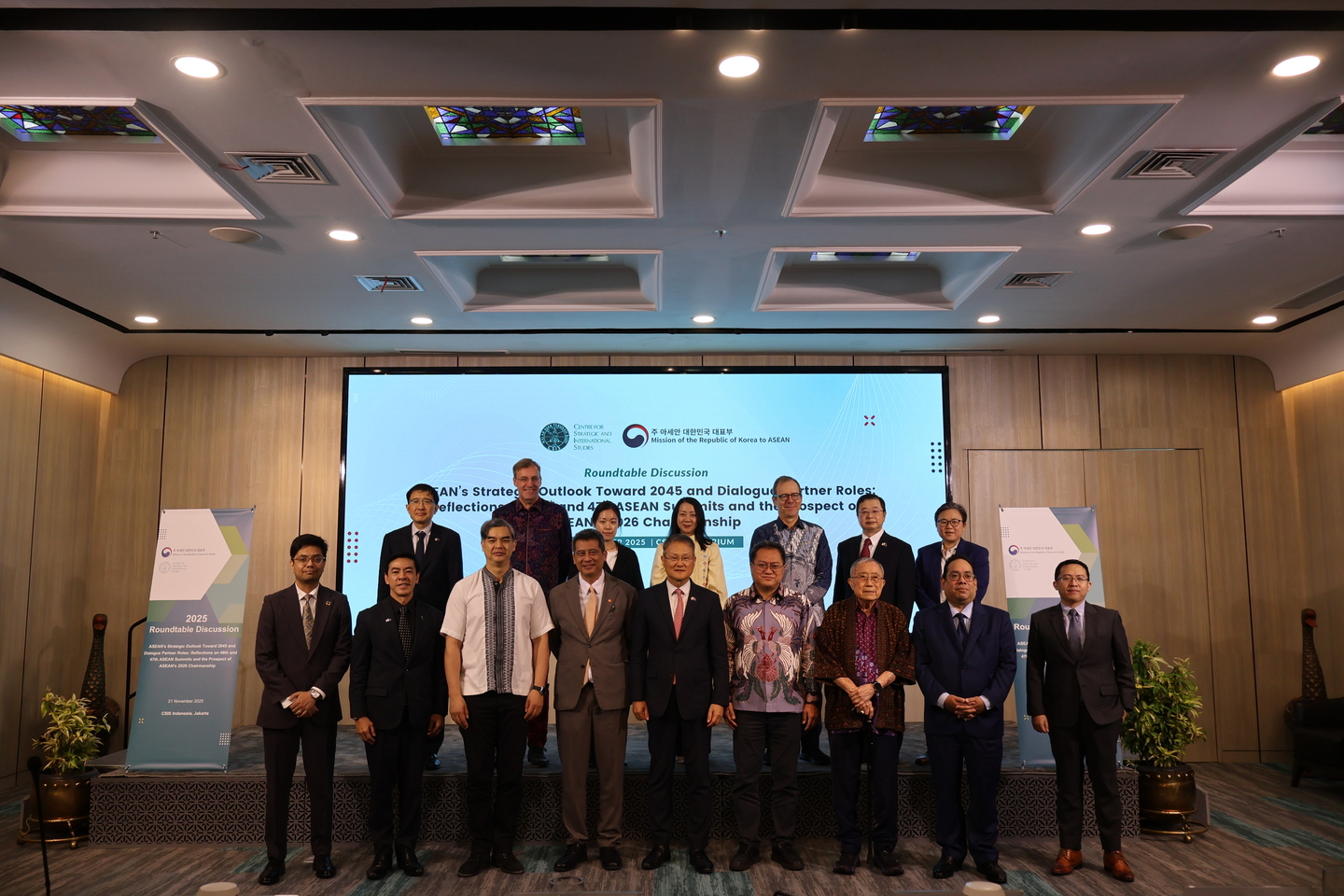
Jakarta, 21 November 2025 — The Centre for Strategic and International Studies (CSIS) Indonesia, in collaboration with the Mission of the Republic of Korea (ROK) to ASEAN, convened a Roundtable Discussion titled “ASEAN’s Strategic Outlook Toward 2045 and Dialogue Partner Roles: Reflections on the 46th and 47th ASEAN Summits and the Prospect of ASEAN’s 2026 Chairmanship.” The event brought together policymakers, diplomats, scholars, and experts to assess ASEAN’s evolving regional role and the contributions of key dialogue partners as the region prepares for its long-term vision.
Welcoming Remarks:
Yose Rizal Damuri, Executive Director of CSIS Indonesia, opened the discussion by acknowledging the presence of the ROK Ambassador and distinguished speakers. He emphasized that after a challenging year for ASEAN, marked by geopolitical tensions and economic uncertainties, the role of dialogue partners has become increasingly vital. The Republic of Korea, he noted, is a particularly strategic partner for ASEAN due to shared interests in stability, sustainable growth, and regional resilience.
Lee Jang-Keun, Republic of Korea Ambassador to ASEAN, expressed appreciation to CSIS for facilitating a platform that brings academics, diplomats, and policymakers together. He underscored that the ROK’s partnership with ASEAN is grounded in innovation, inclusive growth, and long-standing cooperation with CSIS, especially through strategic commentaries and policy dialogues. He emphasized that this roundtable reflects our shared commitment to clarifying strategic direction, strengthening collaboration, and enhancing mutual understanding.
Congratulatory Remarks:
Nararya S. Soeprapto, Deputy Secretary-General of ASEAN for Community and Corporate Affair, congratulated the ROK Mission for its continued commitment to regional cooperation. He highlighted the impact of disruptive technologies, protectionism, and shifting geopolitical dynamics on ASEAN’s future trajectory. Nararya emphasized the significance of the ASEAN–ROK Comprehensive Strategic Partnership (CSP), which continues to expand across critical areas including maritime security, sustainable development, public health, and economic integration—all anchored on ASEAN Centrality.
Suwit Mangkhala, Chargé d’Affaires, a.i. of the Kingdom of Thailand to ASEAN, provided an overview of ASEAN’s direction following the 46th Summit and ahead of the Philippines’ 2026 Chairmanship. He emphasized the importance of ASEAN Vision 2045 that anchored on connectivity, openness, and centrality as the guiding long-term blueprint. Reflecting on the first ASEAN Summit attended by the ROK President, he underscored that the ASEAN–ROK CSP carries deeper meaning beyond formal agreements, advancing cooperation across three pillars: 1) Creative (innovation and digital transformation), 2) Sustainable (green agenda and environmental responsibility), and 3) People-centered (youth, culture, and health cooperation). “Starting is half the task,” he noted, stressing the importance of effective implementation.
Keynote Address:
Syed Edwan Syed Ariff, Deputy Permanent Representative of Malaysia to ASEAN, reflected on the outcomes of the 46th and upcoming 47th ASEAN Summits. He highlighted the need to translate major policy documents into tangible action, particularly in trade, digital transformation, and economic resilience. He welcomed Timor-Leste’s accession process as a step toward a more inclusive ASEAN and emphasized ASEAN’s emerging role in peace negotiations and regional stability. In navigating complex geoeconomic conditions and supply chain disruptions, he called for strengthening dialogue frameworks such as ASEAN+1, ASEAN+3, and sectoral partnerships, while ensuring that initiatives like CEPA deliver real, people-centered benefits.
Roundtable Discussions:
Moderated by Lina Alexandra, Head Department of International Relations at CSIS Indonesia, the roundtable framed the conversation through ASEAN’s achievements amid heightened geopolitical and geoeconomic pressures. Experts discussed how environmental issues, technological disruption, and economic fragmentation increasingly test ASEAN Centrality.
Aaron Jed Rabena, Assistant Professor of Asian Center, University of the Philippines Diliman, outlined Manila’s priorities ahead of its 2026 Chairmanship, including advancing the Code of Conduct (CoC) in the South China Sea, strengthening peace and prosperity agendas, bolstering MSMEs, and deepening digital integration through DEFA. He also addressed upcoming ASEAN partnerships, from GCC to BRICS, and stressed the importance of addressing supply chain security, cross-border crime, and cybersecurity challenges.
Shafiah F. Muhibat, Deputy Executive Director for Research of CSIS Indonesia, examined the policy constraints shaping ASEAN Vision 2045, emphasizing that ASEAN’s ambitions depend on its capacity to evolve institutionally. Persistent structural limitations, she noted, continue to challenge ASEAN’s ability to manage internal disputes and regional crises. She proposed three pathways to advance Vision 2045: institutional reform, pragmatic minilateralism, and a renewed understanding of centrality, enabling ASEAN to respond more decisively to internal and external challenges.
Mirza Sadaqat Huda, Senior Research Fellow, Climate and Sustainability Programme, ODI Global, Singapore; Associate Fellow, ISEAS-Yusof Ishak Institute, highlighted the critical role of energy integration, particularly the ASEAN Power Grid (APG), in strengthening regional resilience. Despite progress, only 9 of 18 interconnection projects have been completed. He emphasized the success of the LTMS-PIP as proof that political will can drive integration, while noting that regulatory harmonization, diversified stakeholders, and stronger digital infrastructure remain key priorities. Energy cooperation, he stressed, must move in parallel with cybersecurity and digital transformation.
Kihyun Bae, Professor, Institute for East Asian Studies at Sogang University, ROK, outlined Korea’s evolving regional diplomacy. She emphasized the ROK’s new policy direction based on pragmatism and strengthened global engagement. She proposed that Korea support ASEAN by contributing to regulatory governance, regional healthcare systems, and digital capacity-building. However, she cautioned that both Korea and ASEAN must engage in more honest and strategic discussions to articulate the added value of their cooperation. “Without clear narratives and strategic communication,” she noted, “the potential of ASEAN–ROK cooperation cannot be fully realized.